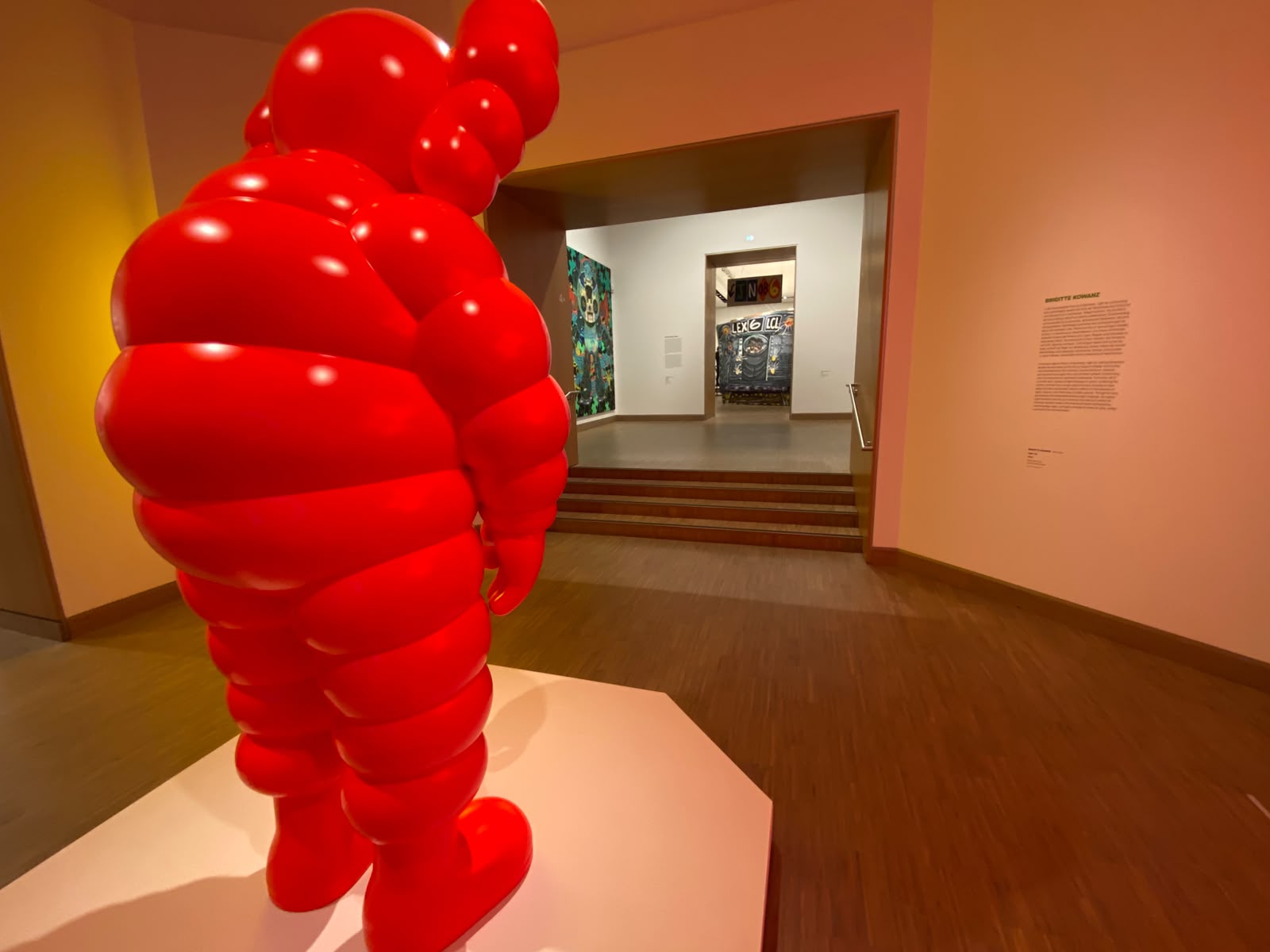
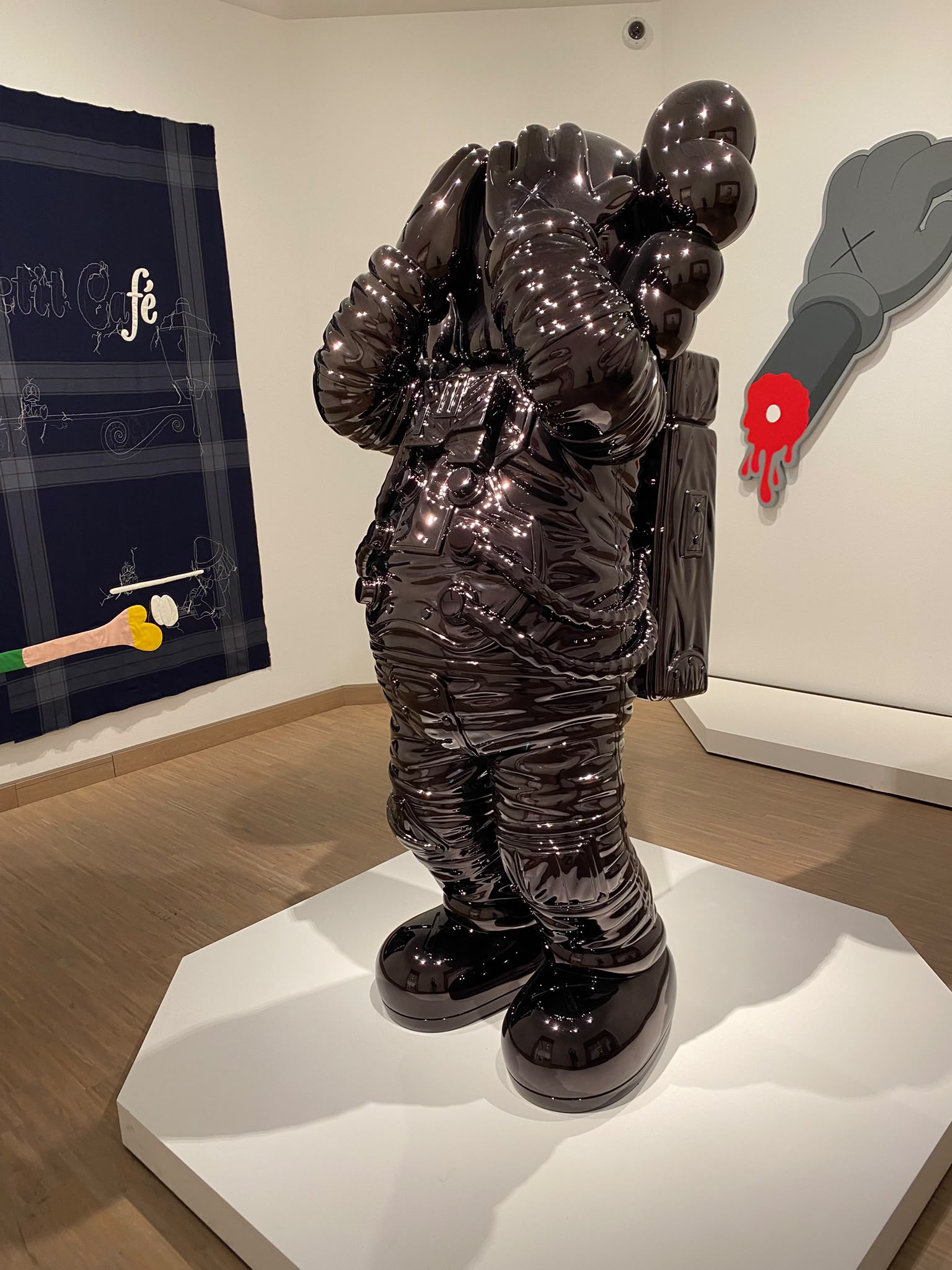
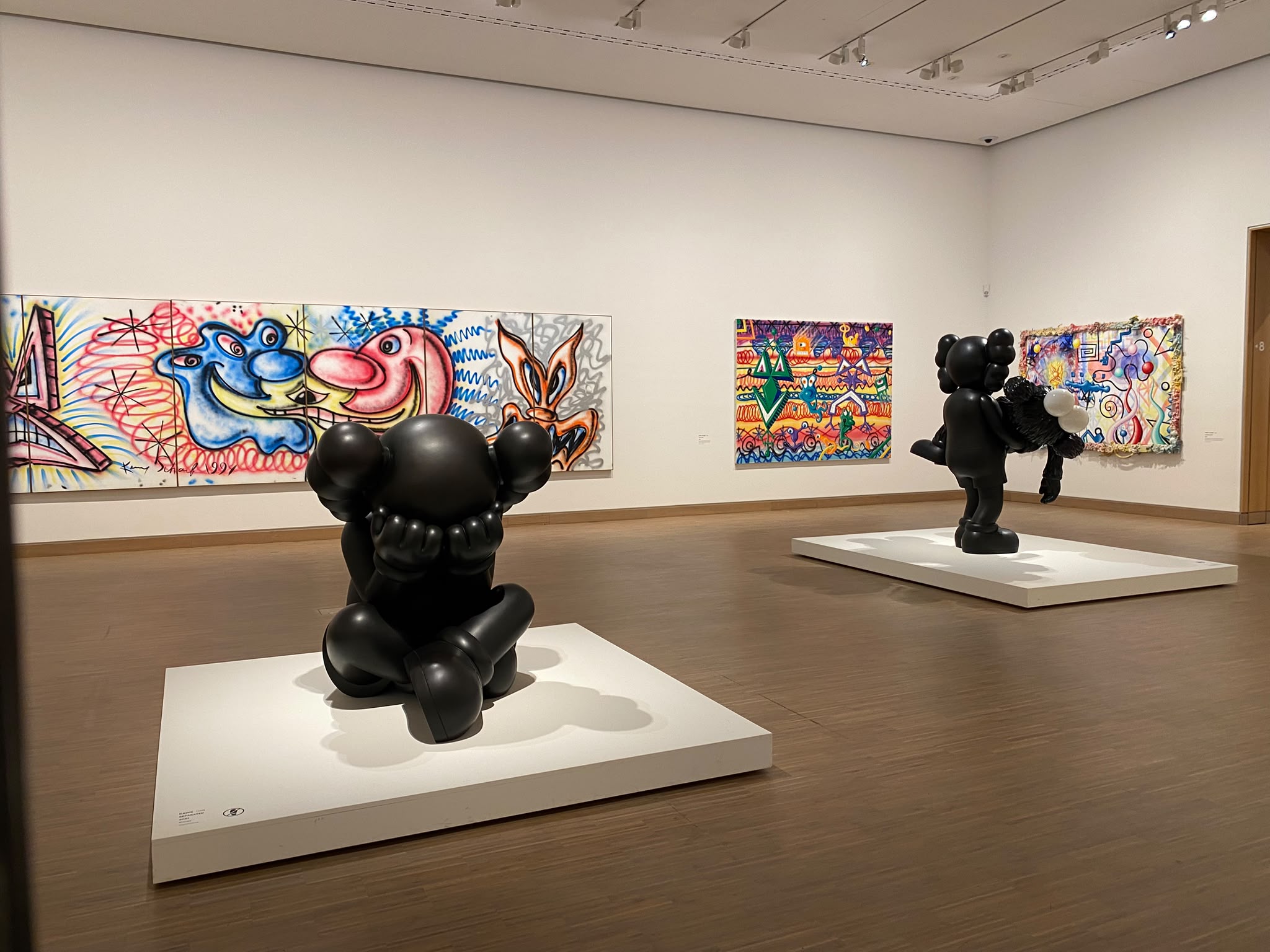
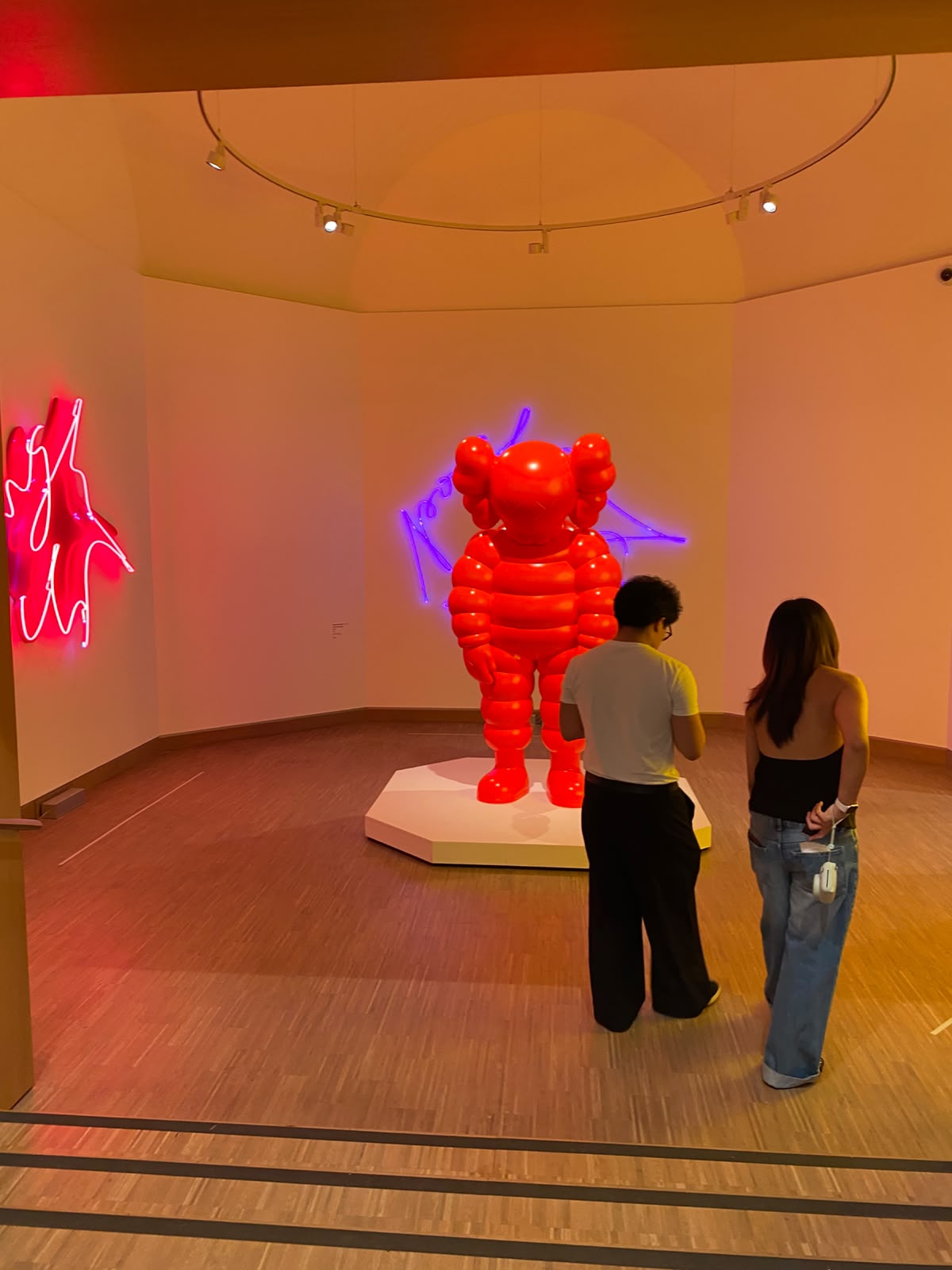
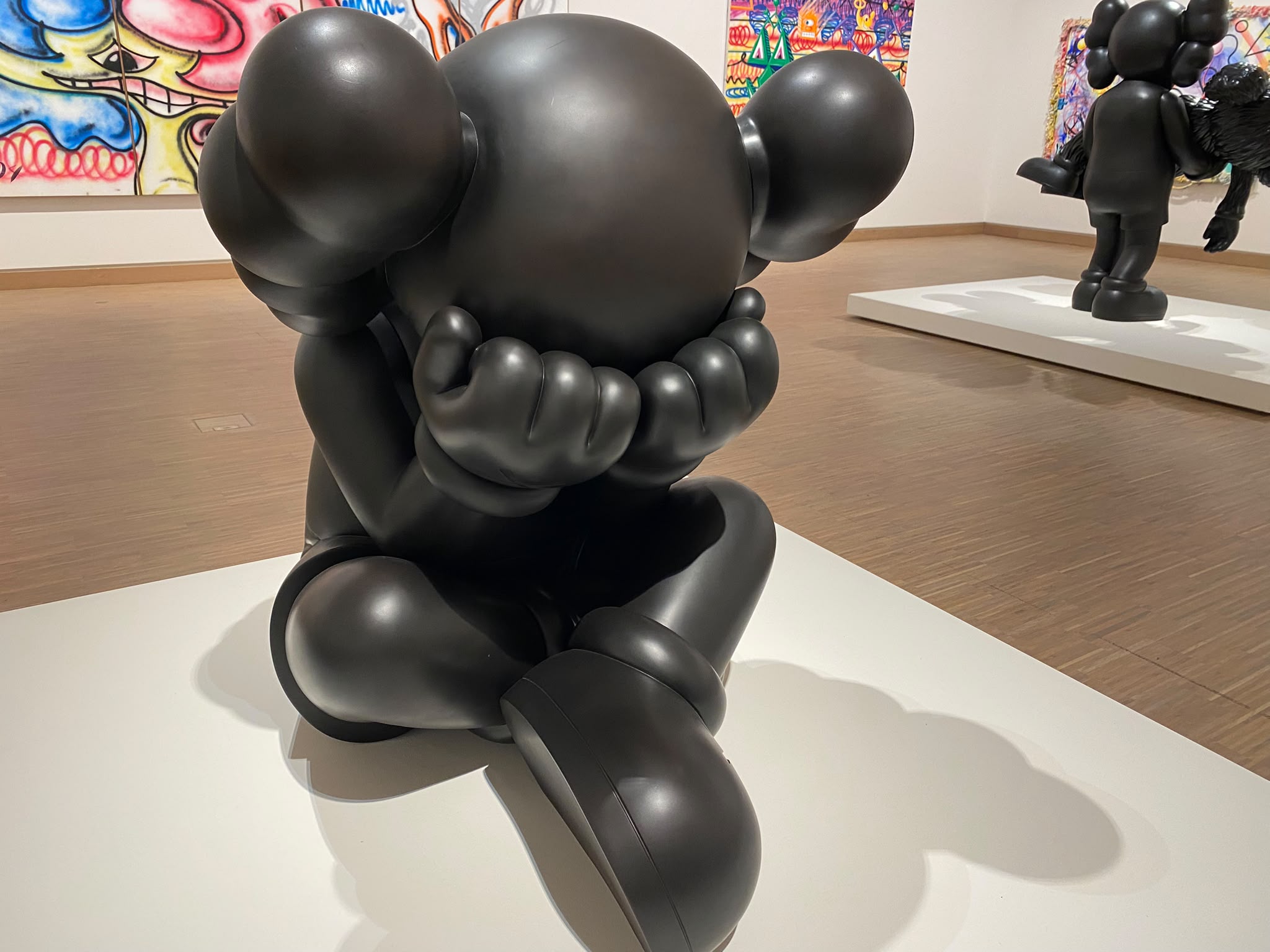
A huge black creature with a pink nose and crosses for eyes reclines in one of the galleries at Vienna’s Albertina Modern. Its pose recalls classical depictions of Venus, though it looks more like a children’s cartoon character thoroughly fed up with adult life. Nearby hangs a painting of the Pink Panther. Appropriate company for an exhibition about how comic-strip characters made their way from cheap newsprint into museums and international auction houses.
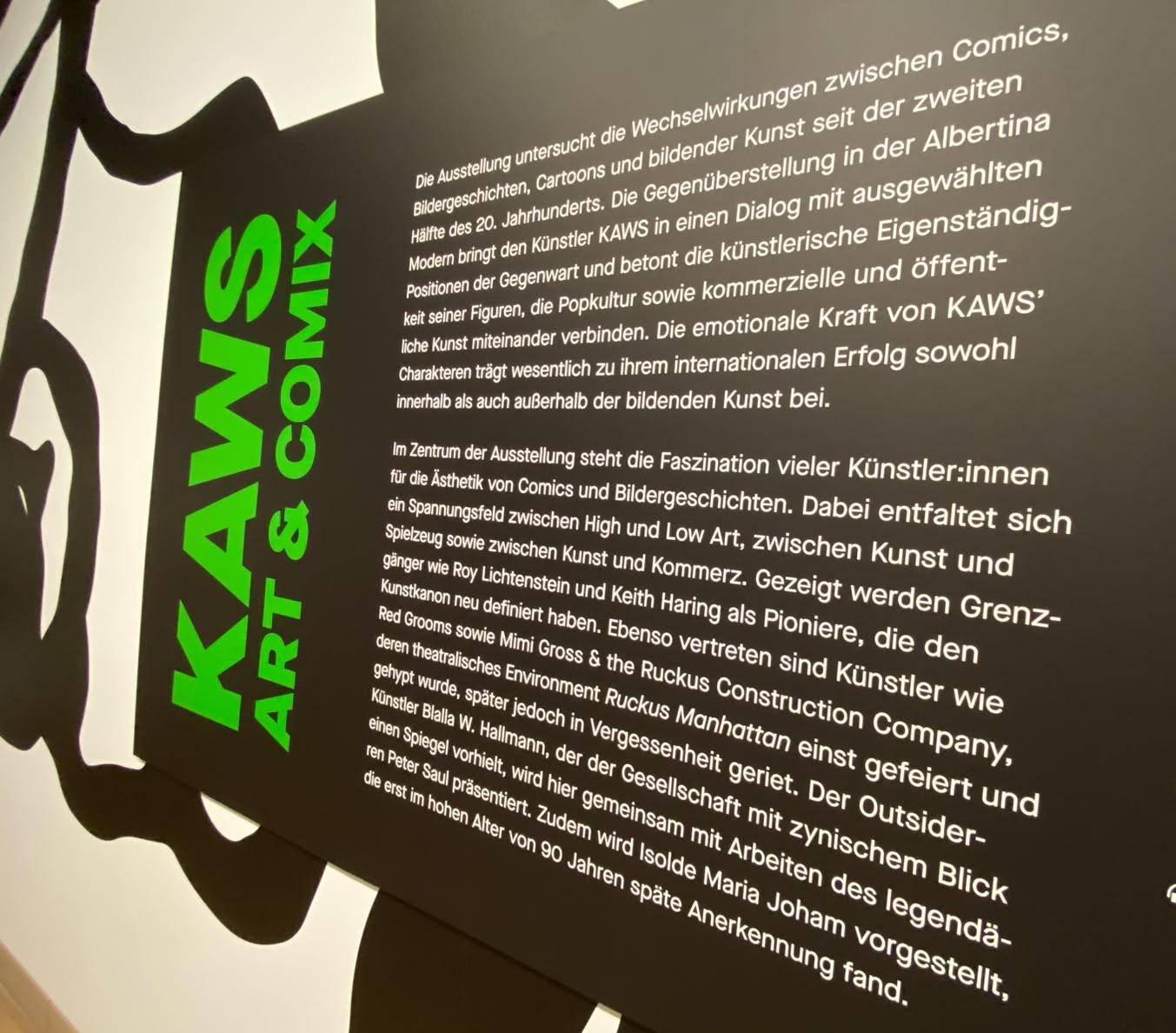
KAWS. Art & Comix, which closes on 27 September, places the American artist Brian Donnelly alongside Roy Lichtenstein, Keith Haring, Jean-Michel Basquiat and others who long ago did away with the boundary between serious art and popular entertainment. KAWS’s own life, however, could supply the plot of a comic book.
From Advertising Display to Auction House
Born in New Jersey in 1974, Brian Donnelly graduated from New York’s School of Visual Arts and worked on animated series including 101 Dalmatians and Daria. His alias, KAWS, means nothing: as a young graffiti artist, he simply liked the way the four letters looked together.
In the 1990s, he devised his own way of dealing with street advertising. He would open the display cases at bus stops, remove posters for Calvin Klein and other well-known brands, add drawings to them and put them back. Models acquired fantastical companions and skulls with crosses for eyes. The advertiser became an unwitting participant in an art project.
As the works became better known, collectors began stealing them. The irony was hard to miss: the artist appropriated other people’s advertising; the public then appropriated his art.
The turning point came in 1999. In Japan, Donnelly released the first vinyl COMPANION figure: a creature with Mickey Mouse’s body, a skull for a face and the now-familiar crosses for eyes. The toy cost about a hundred dollars and came in a limited edition. The character would later grow into monumental sculptures installed in city squares and exhibited in major museums.
What Lichtenstein Taught Mickey Mouse
In 1961, Roy Lichtenstein painted Look Mickey, borrowing a scene from a children’s book about Mickey Mouse and Donald Duck. Enlarging the illustration onto canvas, he carefully reproduced the features of cheap colour printing: bold outlines, a restricted palette and the characteristic pattern of dots.
For his early experiments with printing dots, he even used an ordinary dog-grooming brush, dipping it in paint and pressing it against the canvas. The process was manual, but the result was meant to look entirely mechanical.
Lichtenstein made comics a subject for museum contemplation. He wanted to know what would happen to an image when it moved from mass-produced print into painting.
Andy Warhol took another route. In 1962, he exhibited 32 paintings of Campbell’s soup cans, one for each variety the company produced. A supermarket product proved as worthy of a gallery as a traditional still life.
KAWS brings the two approaches together, but changes their direction. Lichtenstein transferred a comic-strip character onto canvas; Warhol turned a commodity into art; Donnelly created a character that became a commodity in its own right.
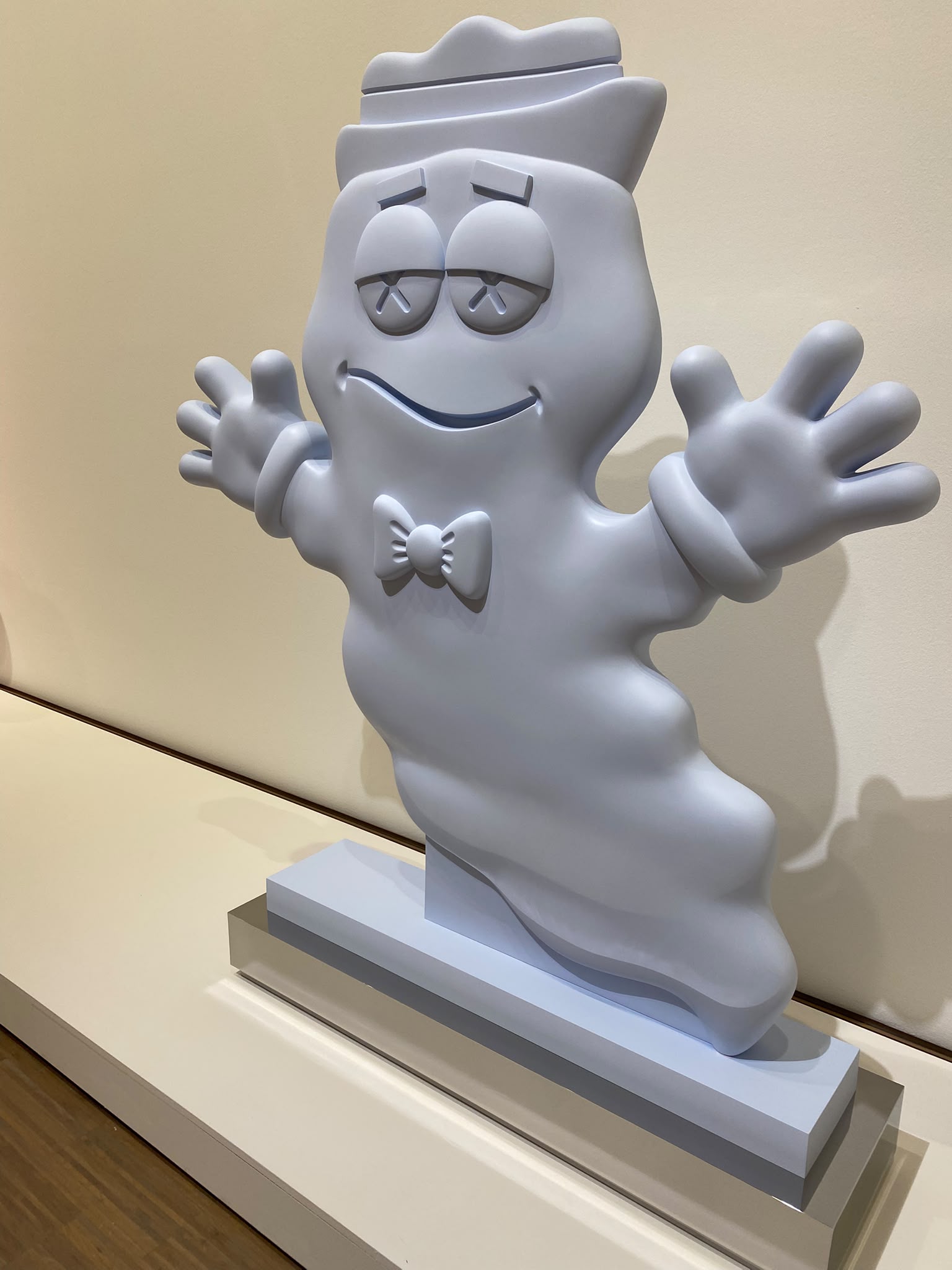
His COMPANION can exist as a drawing, a bronze sculpture, a collectible toy or a print on a T-shirt. It remains recognisable in every form.
Yet while Lichtenstein’s characters are mostly occupied with romantic troubles and adventures, KAWS’s do almost nothing. They sit, embrace, cover their faces with their hands. They have no definite age, no biography, not even an expression in their eyes. Their dejection, however, is surprisingly easy for an adult audience to understand.
Fifteen Million for The Simpsons
In 2019, Donnelly’s painting The KAWS Album sold at Sotheby’s in Hong Kong for US$14.8 million. The characters from The Simpsons, reworked in the artist’s distinctive manner, recreate the famous cover of the Beatles’ Sgt. Pepper’s Lonely Hearts Club Band. A work built on a double borrowing from popular culture became one of the most expensive of his career.
Warhol would probably have appreciated the combination. Donnelly, though, has built a commercial system his predecessor could only have anticipated.
Collaborations with Dior, Nike and Uniqlo have made KAWS’s characters part of the global consumer industry. At the same time, he continues to create unique works priced in the millions.
The question of where art ends and a brand begins remains open. What makes the Vienna exhibition interesting is that it considers KAWS in the company of artists who were grappling with the same questions long before social media, rather than simply as a commercial phenomenon in his own right.
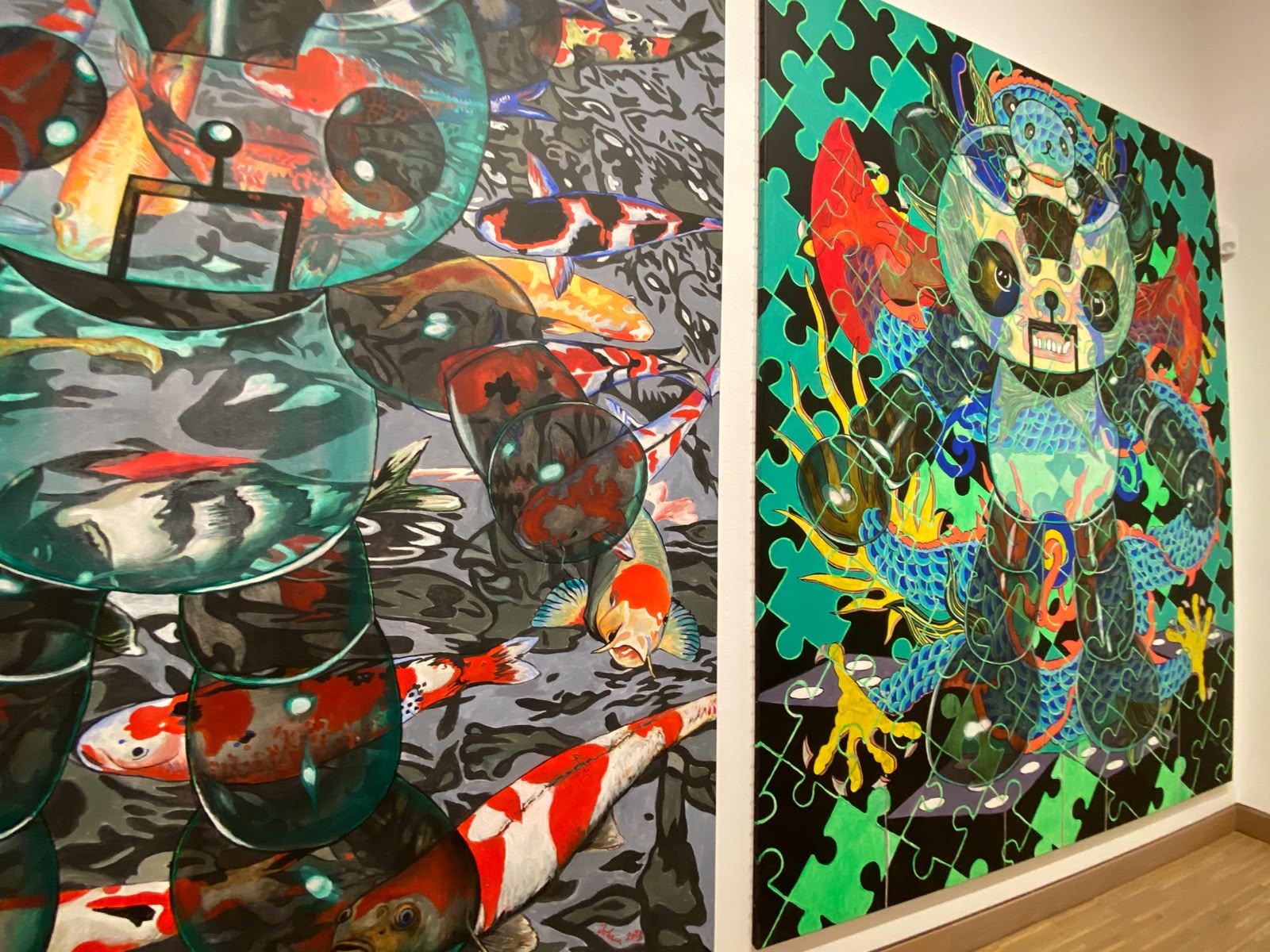
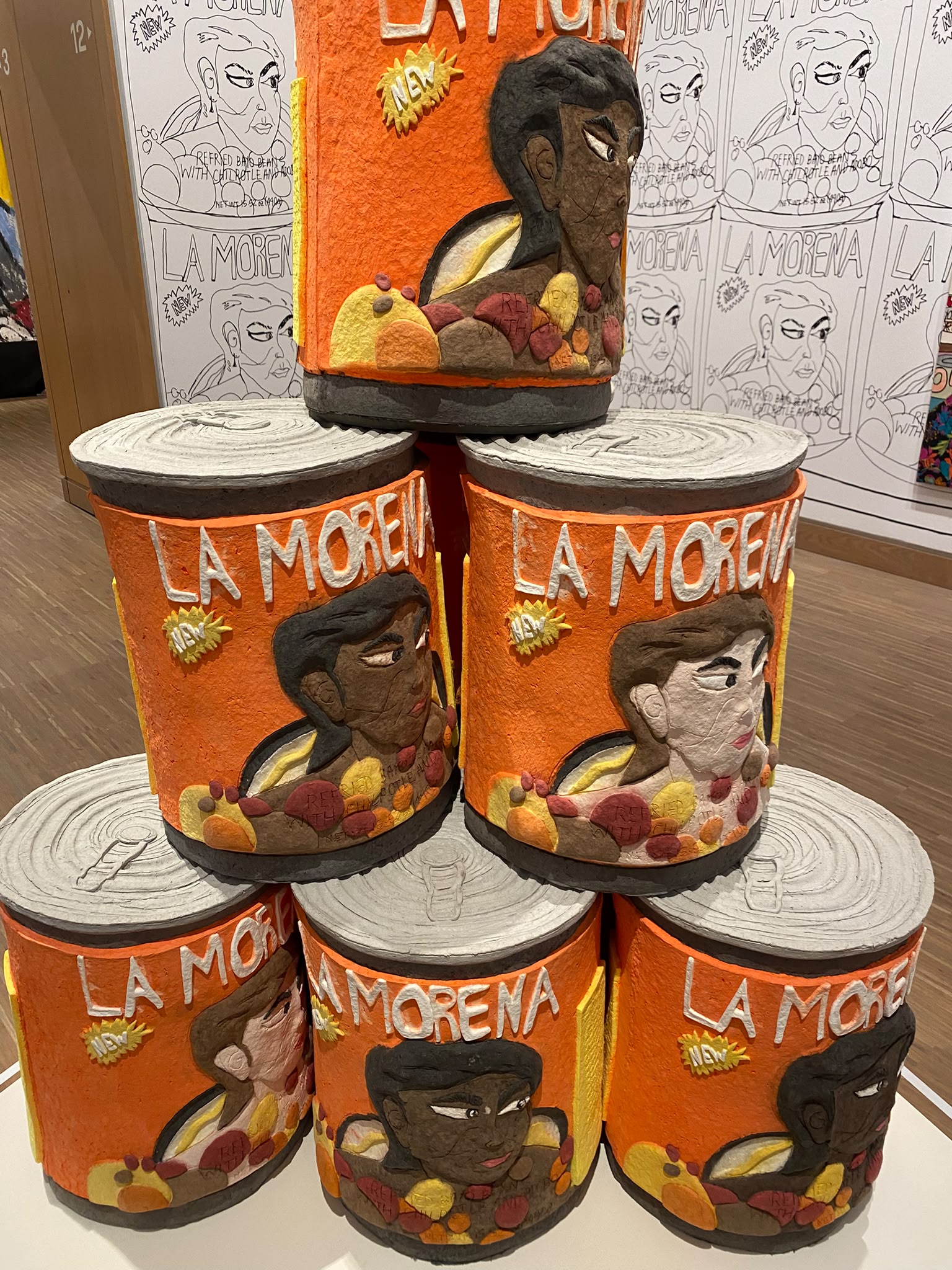
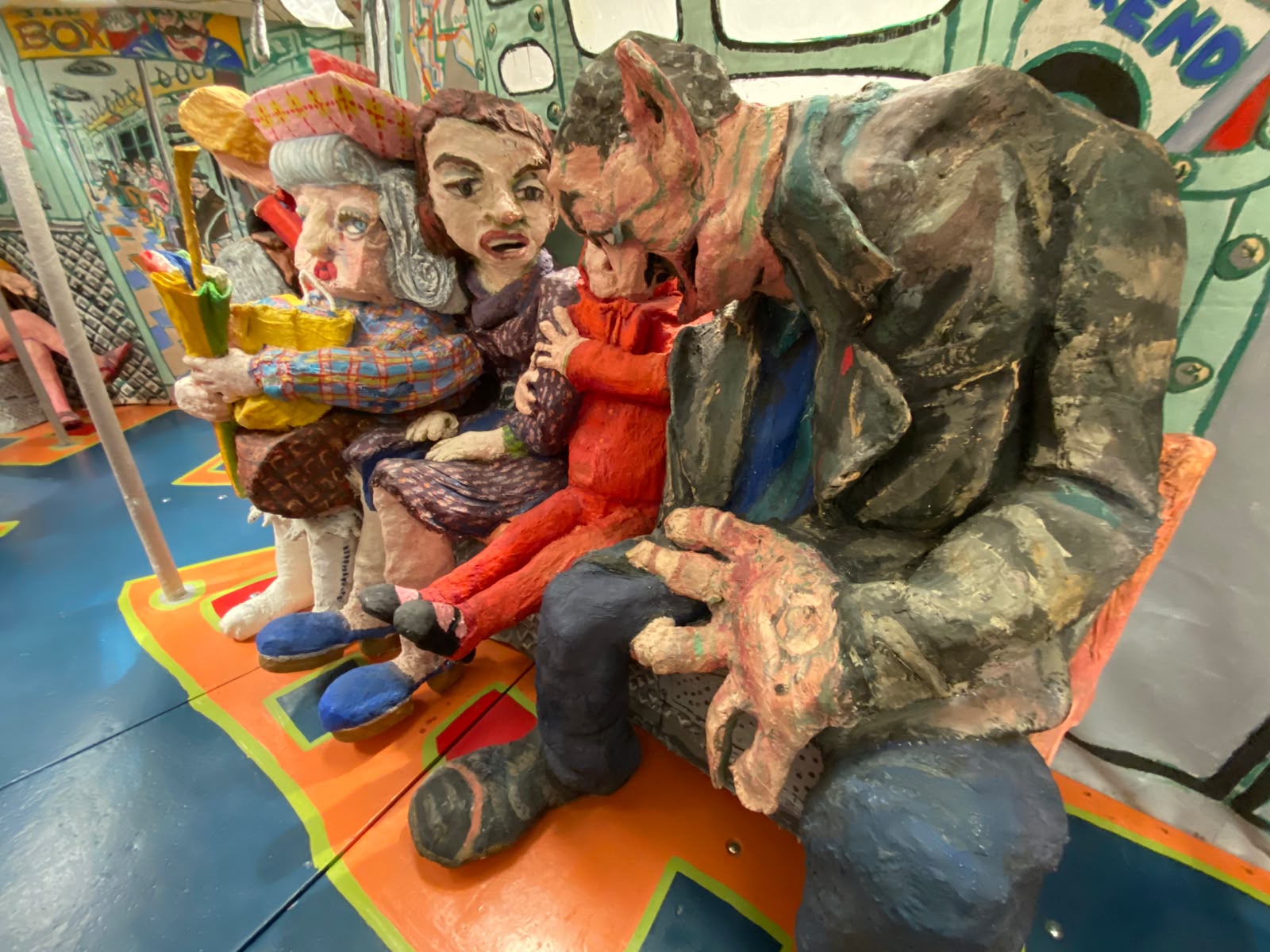
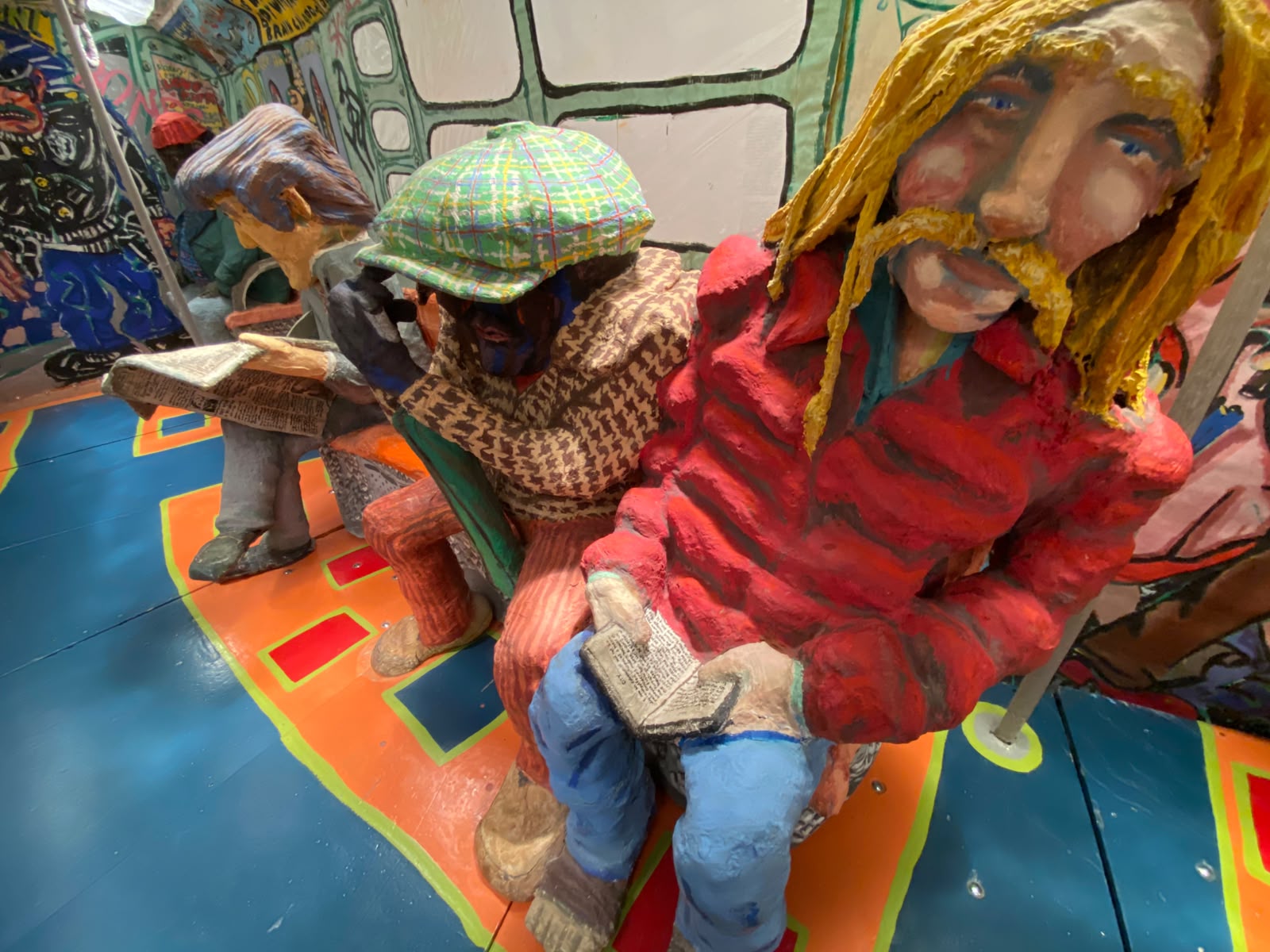
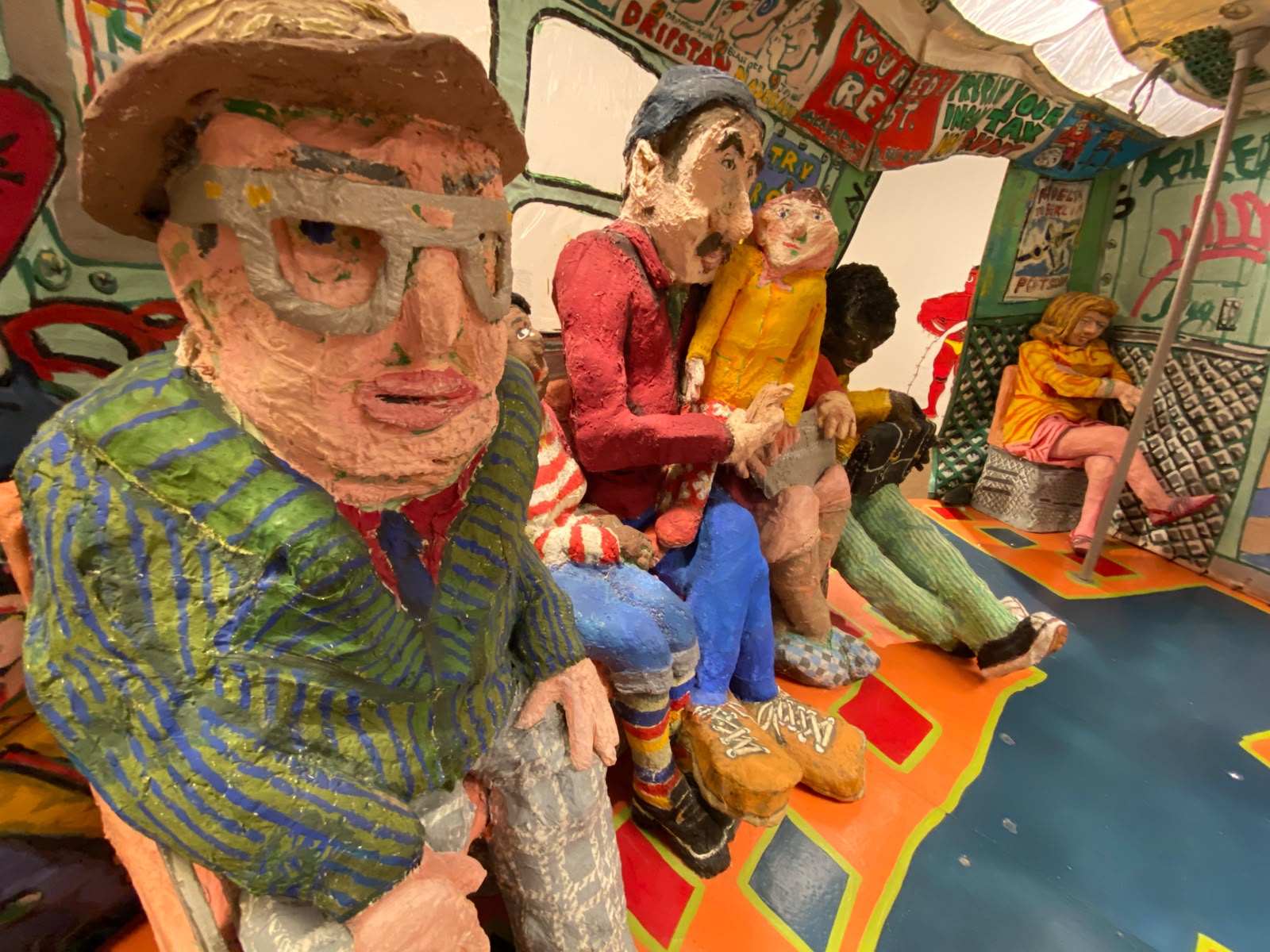
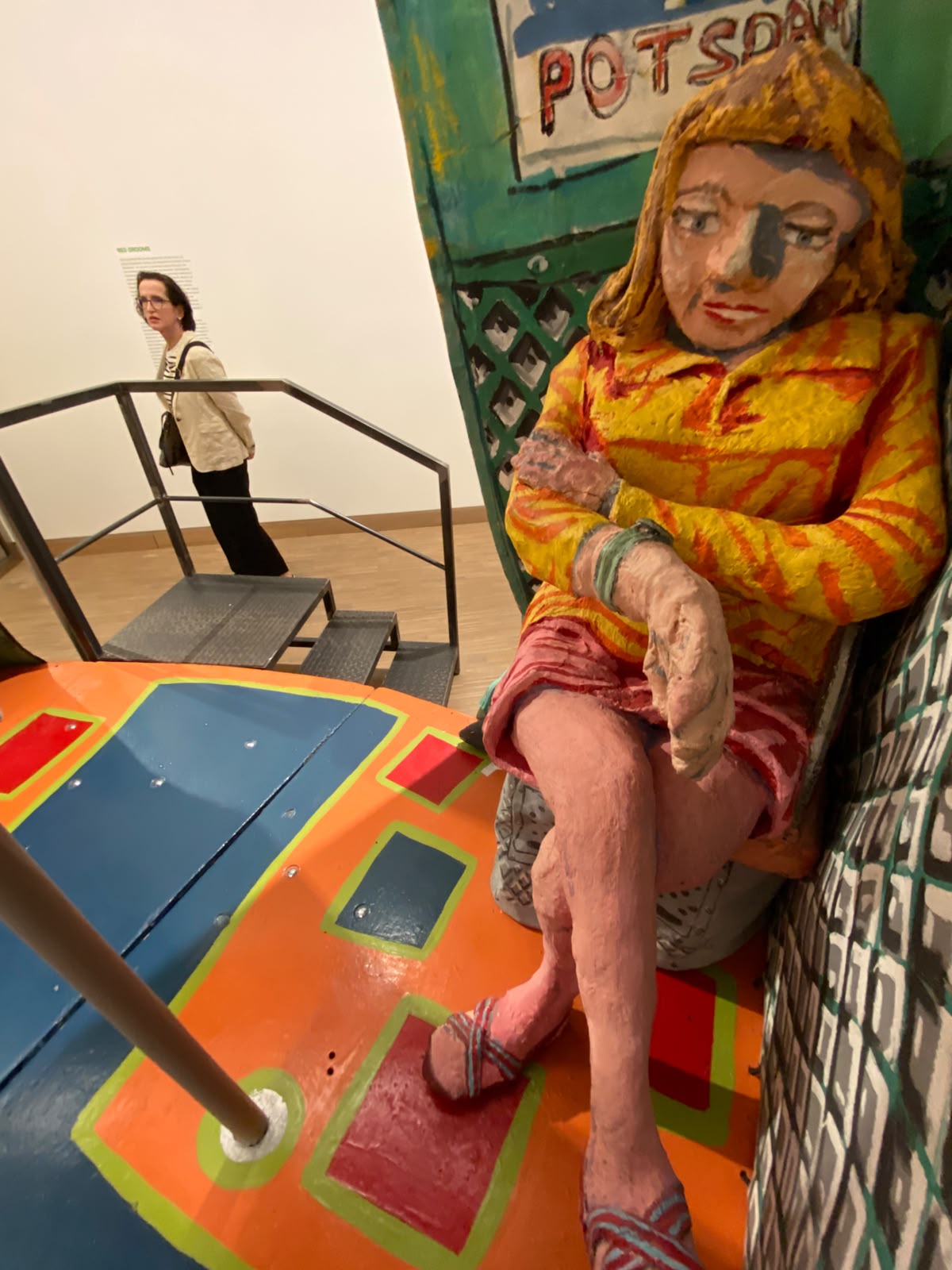
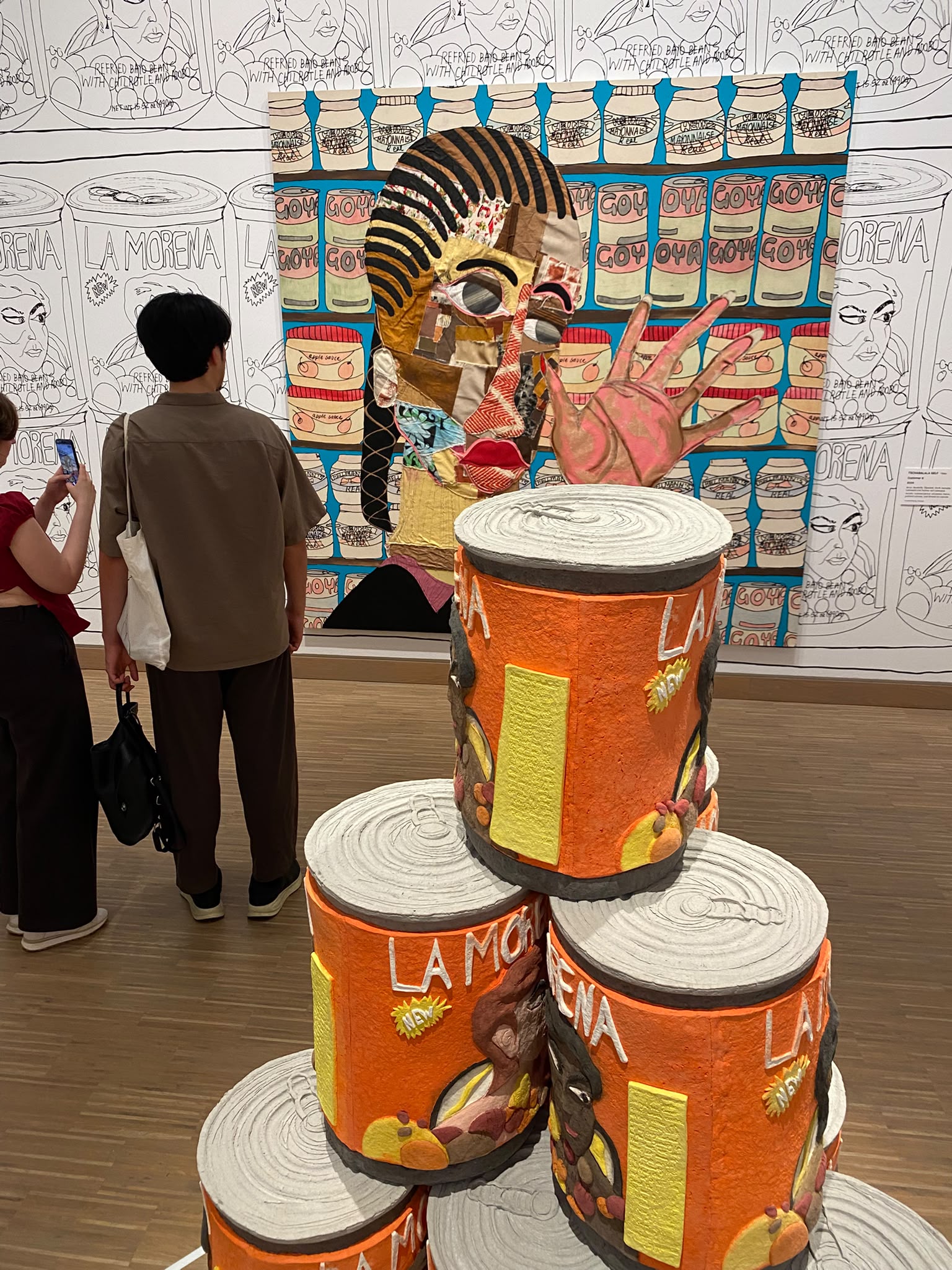
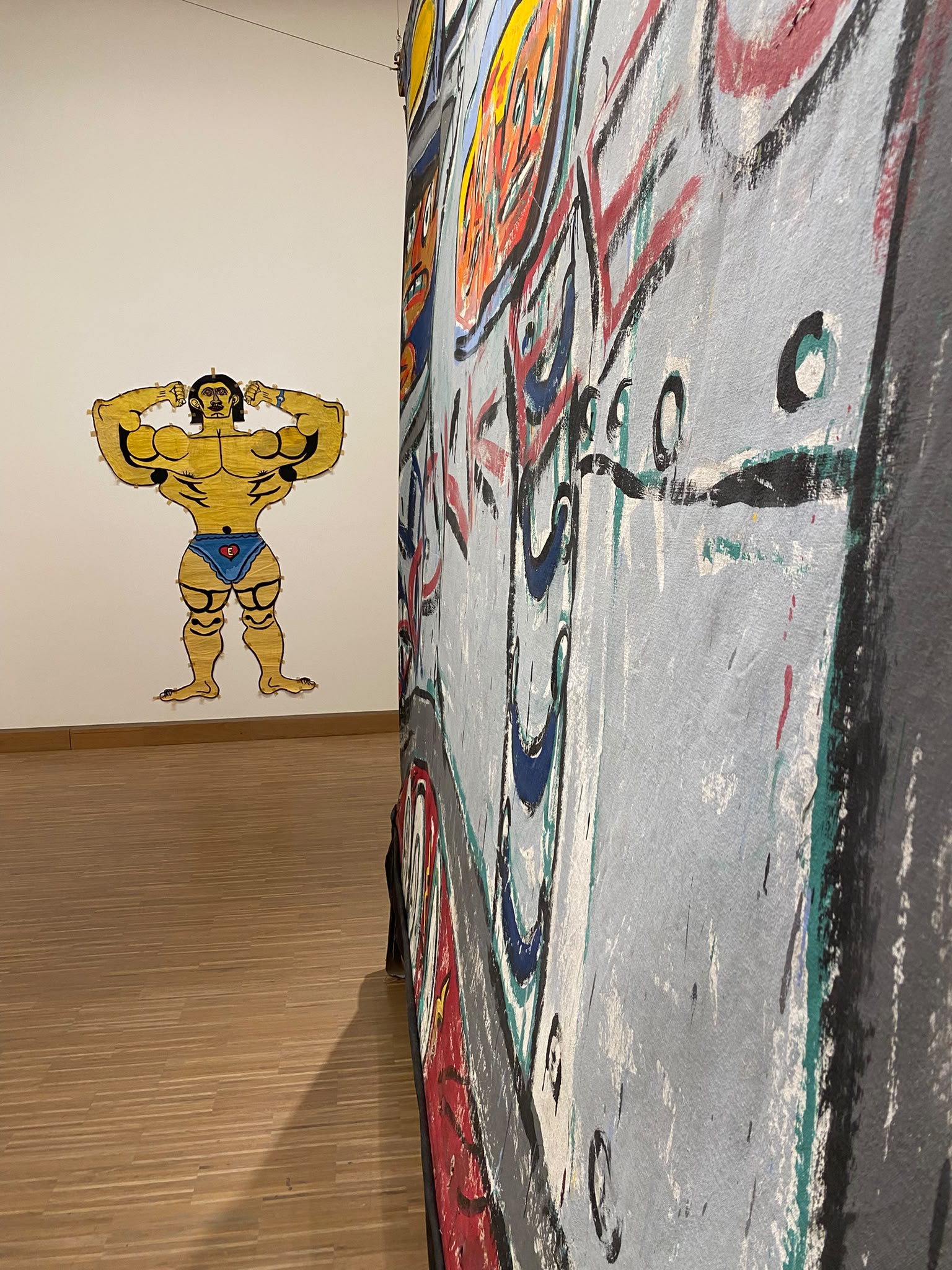
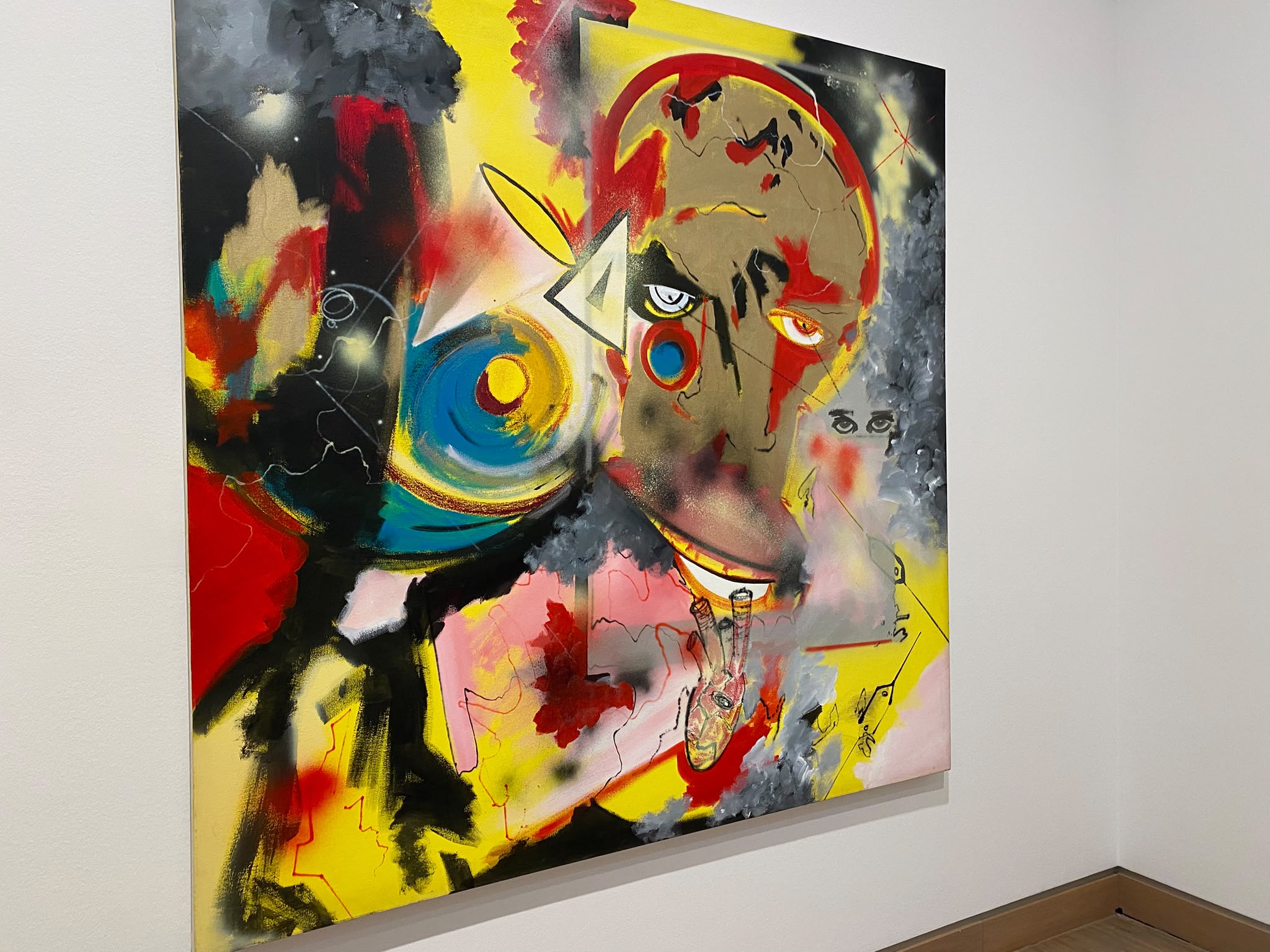
Here are Joyce Pensato’s unsettling versions of Disney characters, Katherine Bernhardt’s Pink Panther and ceramic figures by Magdalena Suarez Frimkess. Each artist gives these familiar characters an entirely unexpected life.
The Albertina That Came from a DIY Store
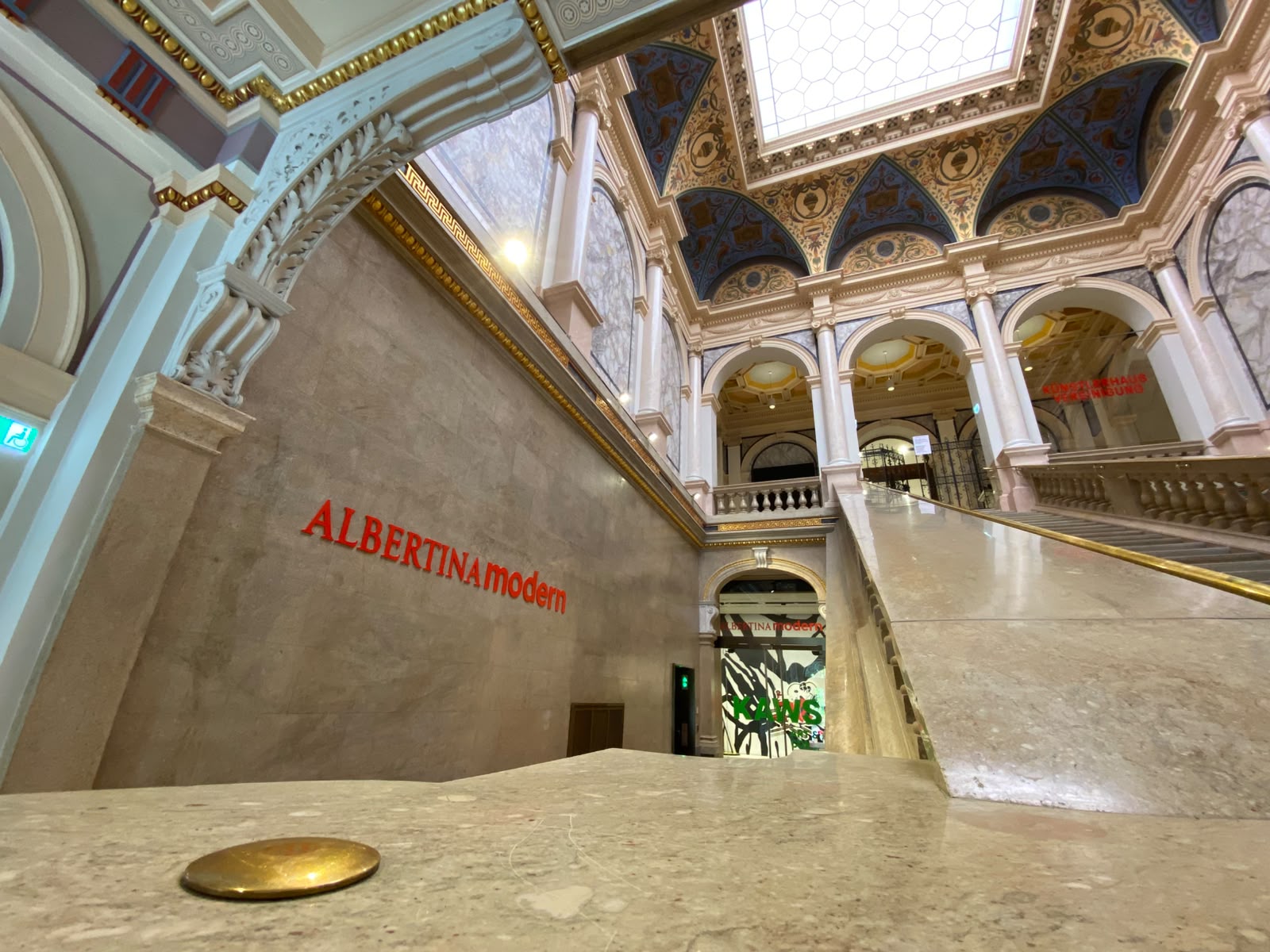
Albertina Modern has an equally curious history. The museum opened on 27 May 2020 in the historic Künstlerhaus on Karlsplatz, built in the nineteenth century for Vienna’s artists’ association.
Its origins are tied to the financial difficulties of the Austrian DIY retail chain bauMax. Its owner, Karlheinz Essl, had assembled one of the country’s largest collections of contemporary art, but the crisis in his business forced him to find a way of preserving it.
The entrepreneur Hans Peter Haselsteiner acquired a substantial share of the collection and later financed the renovation of the Künstlerhaus. The work cost approximately €57 million. The financial troubles of a building-supplies retailer thus helped, unexpectedly, to bring a major new art museum into being.
Today, Albertina Modern has more than 2,000 square metres of exhibition space. Its collection comprises over 60,000 works by 5,000 artists. The historic building has retained its grand nineteenth-century architecture while acquiring the infrastructure of a modern museum.
It is a fitting setting for the current exhibition. KAWS’s sculptural characters, born in the worlds of street advertising and collectible toys, seem as much at home here as any traditional museum exhibit.

Childhood Is Over
The most intriguing thing about KAWS’s art is neither its auction records nor even those instantly recognisable crosses for eyes. His characters look as though they belong in a child’s bedroom, but behave like people who left childhood behind long ago.
They are tired and embarrassed. Sometimes they need a hug; sometimes they prefer to be alone. Unlike Disney characters, they are under no obligation to defeat evil or have a good time.
Lichtenstein showed that comics could become painting. Warhol demonstrated that an everyday consumer product deserved artistic attention. KAWS offered contemporary viewers something different: the chance to recognise their own feelings in a plastic toy.
Perhaps that is why his characters are so popular with adults. Children have yet to grow into these toys.
KAWS. Art & Comix runs through 27 September 2026 inclusive. Albertina Modern, Karlsplatz 5, Vienna. Open daily, 10 am–6 pm. Admission: €17.90.
More from the Exhibition
Text, photographs and video by Aleksei Sholokhov. Originally published in Russian in Gorod 812 on 25 September 2026. Read the original article.