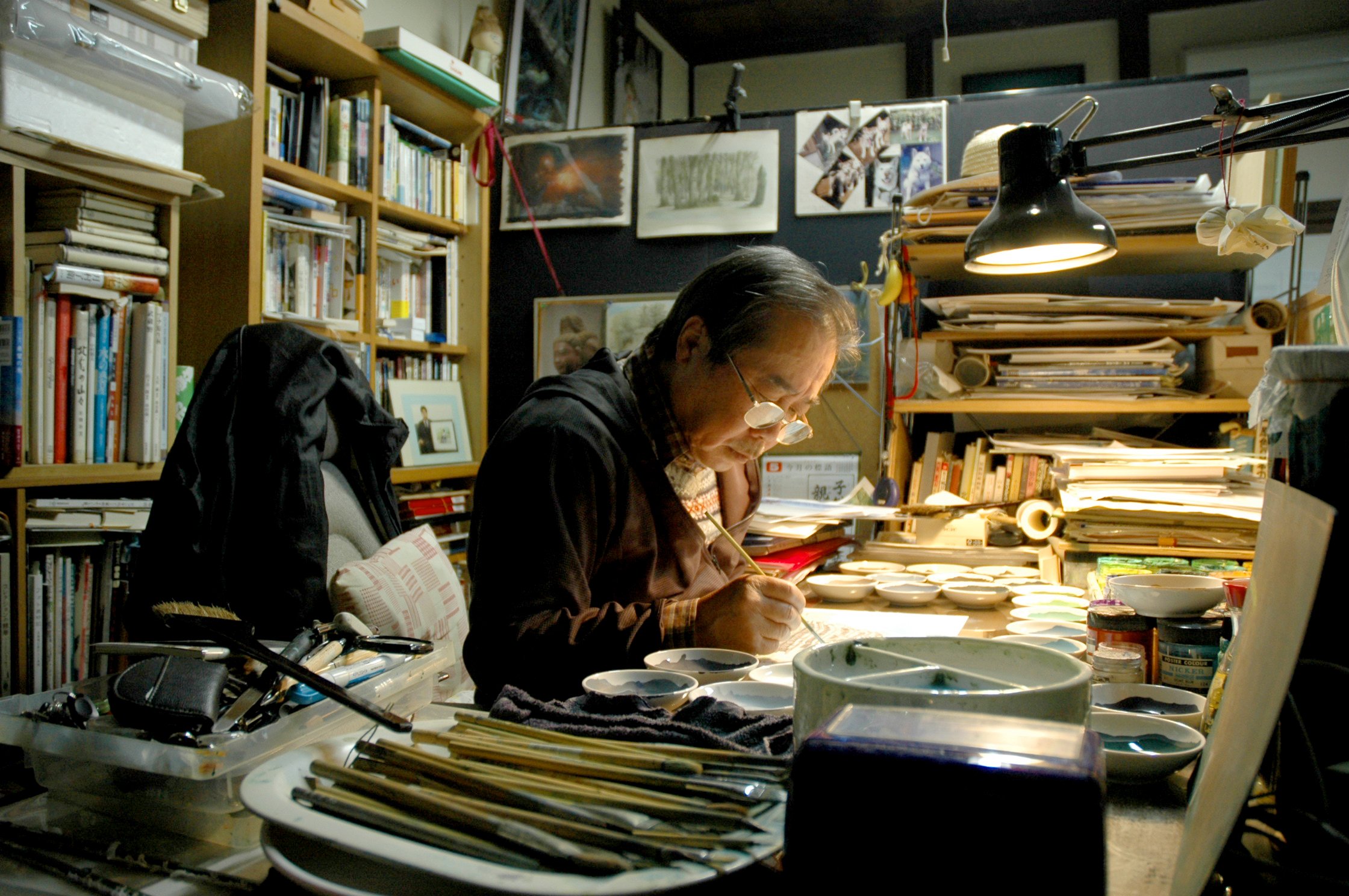
On 2 October, Berlin’s Tchoban Foundation Museum for Architectural Drawing opened the first comprehensive exhibition of Nizō Yamamoto’s work outside Japan. Curator Stefan Riekeles spent three years preparing it. Around 120 original works reveal how an artist with an architectural education created the spaces of films by Miyazaki, Takahata and Hosoda—and how much our experience of those films depends on decisions made before a character enters the frame.
Nizō Yamamoto: Master of Anime Scenography opened to the public on 3 October 2026. In Japan, touring exhibitions of Yamamoto’s work have attracted more than a million visitors. For a long time, the international fame of his images existed quite separately from recognition of his name: audiences knew the forest in Princess Mononoke and the sky in The Girl Who Leapt Through Time, while attributing the entire visual experience primarily to the director.
“Miyazaki’s world” is a convenient expression, but it conceals the workings of a collective endeavour. Between a director’s conception and the finished frame lie artists’ decisions about scale, colour, texture and spatial depth. The exhibition makes Yamamoto’s contribution to that process visible. His authorship emerges in the particular way he gives a shared conception visual form.
Such a subject belongs naturally in an architectural museum. In 2016, the Tchoban Foundation presented Anime Architecture, featuring the cities of Patlabor and Ghost in the Shell; in 2022 came AKIRA—The Architecture of Neo Tokyo. The present exhibition extends that discussion: convincing space in animation depends as much on the painting of water, vegetation and clouds as on the arrangement of a house.
A house before its inhabitant
Yamamoto was born in 1953 on the Gotō Islands in Nagasaki Prefecture. After junior high school he moved to Gifu, where he studied architecture at high school. He continued his art education in Tokyo and began painting animation backgrounds while still a student. In 1978, he became art director of Future Boy Conan. He later worked on Castle in the Sky (1986), Isao Takahata’s Grave of the Fireflies (1988), Princess Mononoke (1997) and Mamoru Hosoda’s The Girl Who Leapt Through Time (2006).
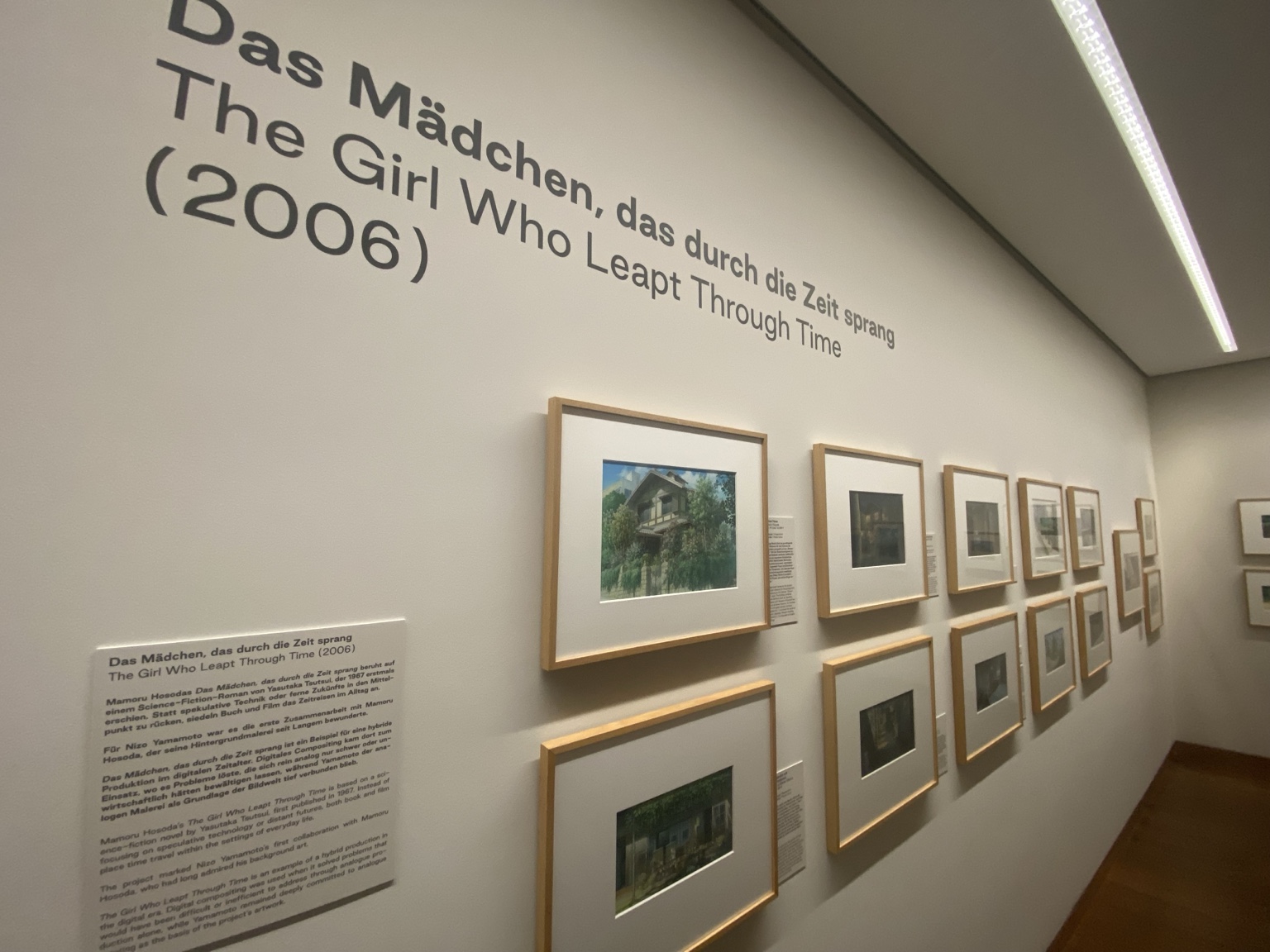
His architectural training matters here for a thoroughly practical reason. A house in a film must retain its internal logic as the viewpoint changes: viewers recognise a room, understand the direction of movement and imagine what lies beyond a door. If several artists are to depict the same place consistently, its arrangement must be agreed in advance.
For The Girl Who Leapt Through Time, Yamamoto developed plans for the protagonist’s house; 45 artists worked on the film’s backgrounds. The house was conceived as an adapted home belonging to an older generation of the family, combining a Japanese foundation with Western elements. Its plan gave it a biography: present-day life continued inside a space shaped by the past.
The artist’s museum on Gotō recounts a revealing episode. Looking at a house plan for Grave of the Fireflies, Miyazaki remarked that the bathroom was too large. The room never appeared in the film. Behind this apparent quibble lies a professional principle: the credibility of an individual frame rests on an understanding of the whole building, including the parts we never see.
In animation, this work passes through several stages: exploratory sketches establish mood and colour, followed by the development of settings and shot layouts, and finally the finished backgrounds. Yamamoto often participated in several stages himself. This kept the spatial design connected to the initial painterly conception.
A forest designed for twenty seconds
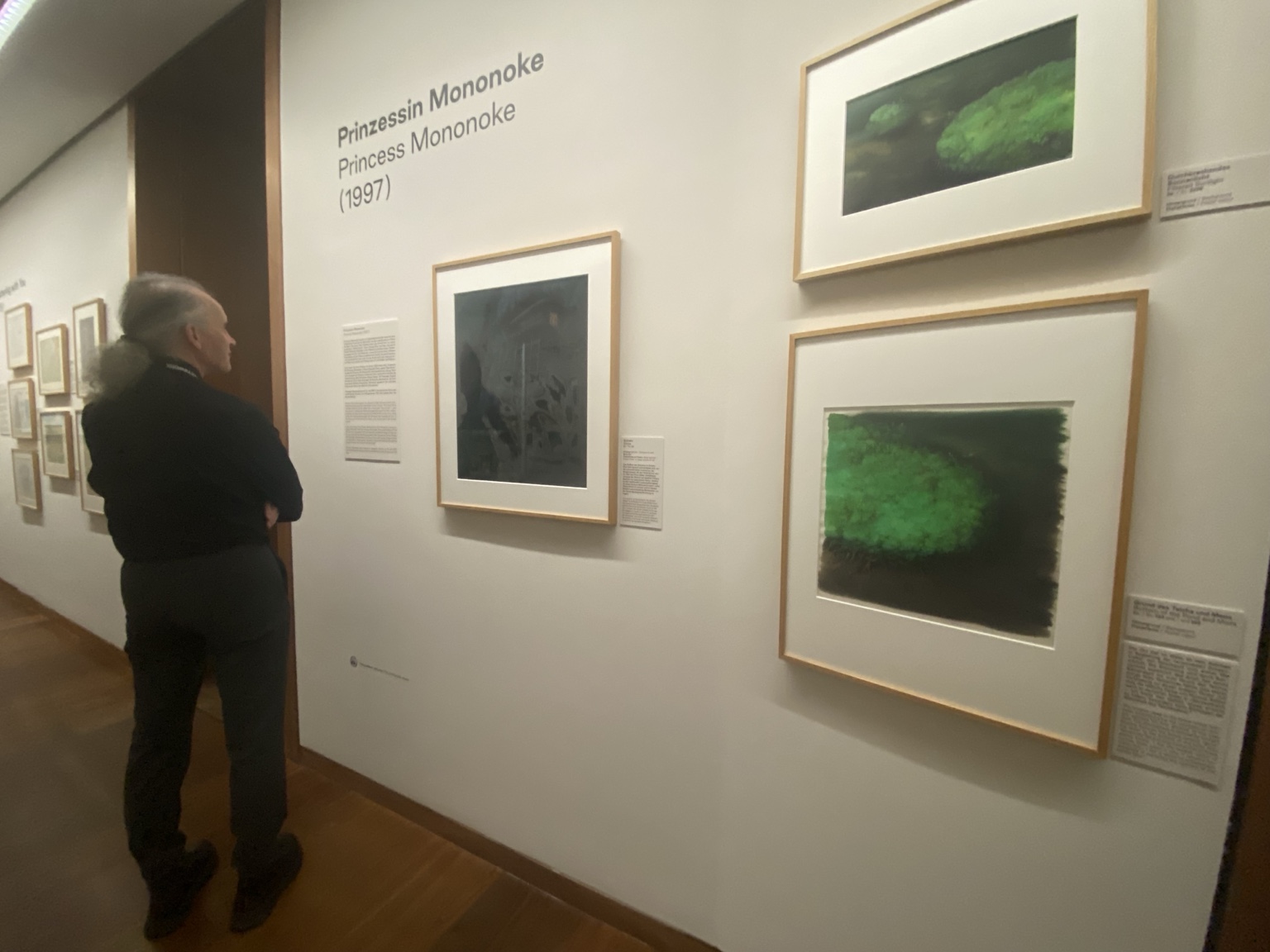
The panorama of the Forest of the Deer God in Princess Mononoke offers a particularly clear example. The background for scene 316 is 157 centimetres long. Yamamoto spent two weeks painting it; the camera takes approximately twenty seconds to move across it. There is no music or dialogue in the scene, only the sounds of the forest.
The composition is designed to unfold gradually. The eye moves towards an opening in the canopy, the direction of the light changes, and bright edges appear on the leaves. Dark water reflects moss-covered trunks; decaying trees lie beside new growth. The duration of the shot allows us to notice these relationships and sense the place’s independent life.
Before work on the film, Yamamoto travelled to Yakushima with the production team. Observation on location gave the vegetation its specific forms and textures. Yet the forest’s credibility also depends on how those details are selected and arranged: which areas the eye can enter, what remains in shadow, where water connects the foreground and the distance.
Here, painting contributes directly to the film’s meaning. The forest is experienced as an environment with processes and a timescale of its own, vulnerable to disruption by human conflict. Nature’s independence must be felt before the characters begin to discuss it.
The shared language of a film
Space works differently in Eyvind Earle’s designs for Disney’s Sleeping Beauty (1959). Gothic art, Persian miniatures and European painting supplied the material for a consistently stylised world. Trees, architecture and ornament follow a common rhythm; every element sustains the graphic order of the whole.
The Walt Disney Family Museum recounts that some animators objected to the backgrounds’ independence: the settings drew attention away from the characters. Earle could spend as long as ten days on a single background. The dispute was, in effect, about the distribution of expressive force within a frame—how much of the audience’s attention the surrounding world was entitled to claim.
The comparison with Yamamoto is interesting precisely because their approaches differ. Earle achieves unity through emphatic stylisation. Yamamoto gives an imagined place the credibility of an observed environment: objects retain their material specificity, while light and atmospheric perspective make distances legible. In both cases, the artist establishes the visual conditions in which the story will unfold.
Mary Blair influenced Disney films above all through concept art and colour design. Her work on Cinderella, Alice in Wonderland and Peter Pan demonstrates how far an individual artistic conception can extend even when the finished images are produced by a large team. Later, in the it’s a small world attraction for the 1964–65 World’s Fair, her visual language was translated into a three-dimensional environment.
Earle, Blair and Yamamoto occupied different positions in film production. What unites them is the ability to establish principles through which many separate images become a recognisable world. Here the comparison with an architect becomes particularly useful: authorship includes organising collective work and maintaining a sequence of decisions capable of surviving changes of hands.
Ice, fog and the living forest
A related example in Soviet animation is Francheska Yarbusova, the production designer of Yuri Norstein’s The Heron and the Crane, Hedgehog in the Fog and Tale of Tales. In Hedgehog, her drawings combine with Norstein’s direction and Alexander Zhukovsky’s cinematography. The result is a space that viewers must discover at the same time as the protagonist.
Fog restricts visibility and deprives familiar objects of a stable scale. We cannot judge a distance in advance, identify a silhouette or be sure that the next step is safe. Drama arises from incomplete vision. Yamamoto’s forest, by contrast, is elaborately described, yet access to detail does not mean that a person understands its order. In both cases, the environment determines the protagonist’s position: knowledge is limited, and the character’s abilities extend to only a small part of the surrounding world.
Leonid Shvartsman and Alexander Vinokurov established a different relationship between people and their surroundings in Lev Atamanov’s The Snow Queen (1957). The journey from the inhabited town to the ice palace changes the very idea of a space for living. Domestic closeness implies human intimacy and everyday activity. Vast, cold halls emphasise isolation; their geometric clarity is accompanied by an absence of human warmth.
This is a significant distinction from the forest in Mononoke. The ice palace overwhelms a person through stillness and order; the forest does so through the scale of processes unfolding independently of human life. With Yarbusova, unease comes from being unable to see the world clearly; with Yamamoto, from being unable to regard oneself as its measure. The comparison becomes meaningful when we notice the relationship with the surrounding world that each artist proposes.
Yet audiences rarely separate such decisions from the director’s name. Shvartsman encountered a similar pattern of perception in character design: Cheburashka’s screen appearance emerged through his drawings and discussions with Roman Kachanov, then came to seem the only possible version. The more convincing an image becomes, the less visible the history of its making.
The drawing after the film
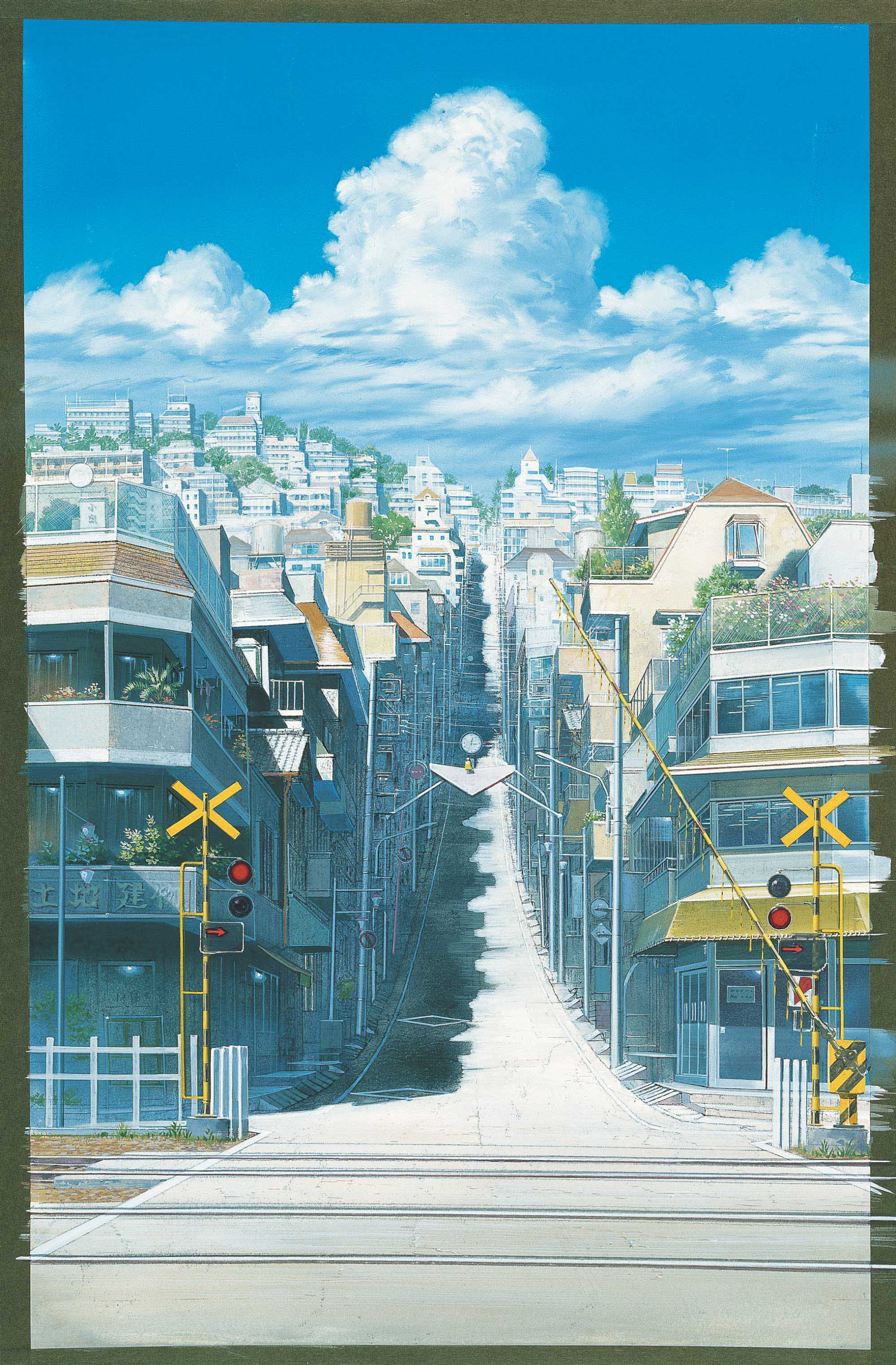
There is one motif that audiences have associated directly with Yamamoto’s name: the towering cumulus formations known as Nizō-gumo, or “Nizō clouds”. In The Girl Who Leapt Through Time, their volume and lighting give the summer sky an exceptional spatial presence. An ordinary urban setting acquires a scale beyond the characters’ immediate concerns.
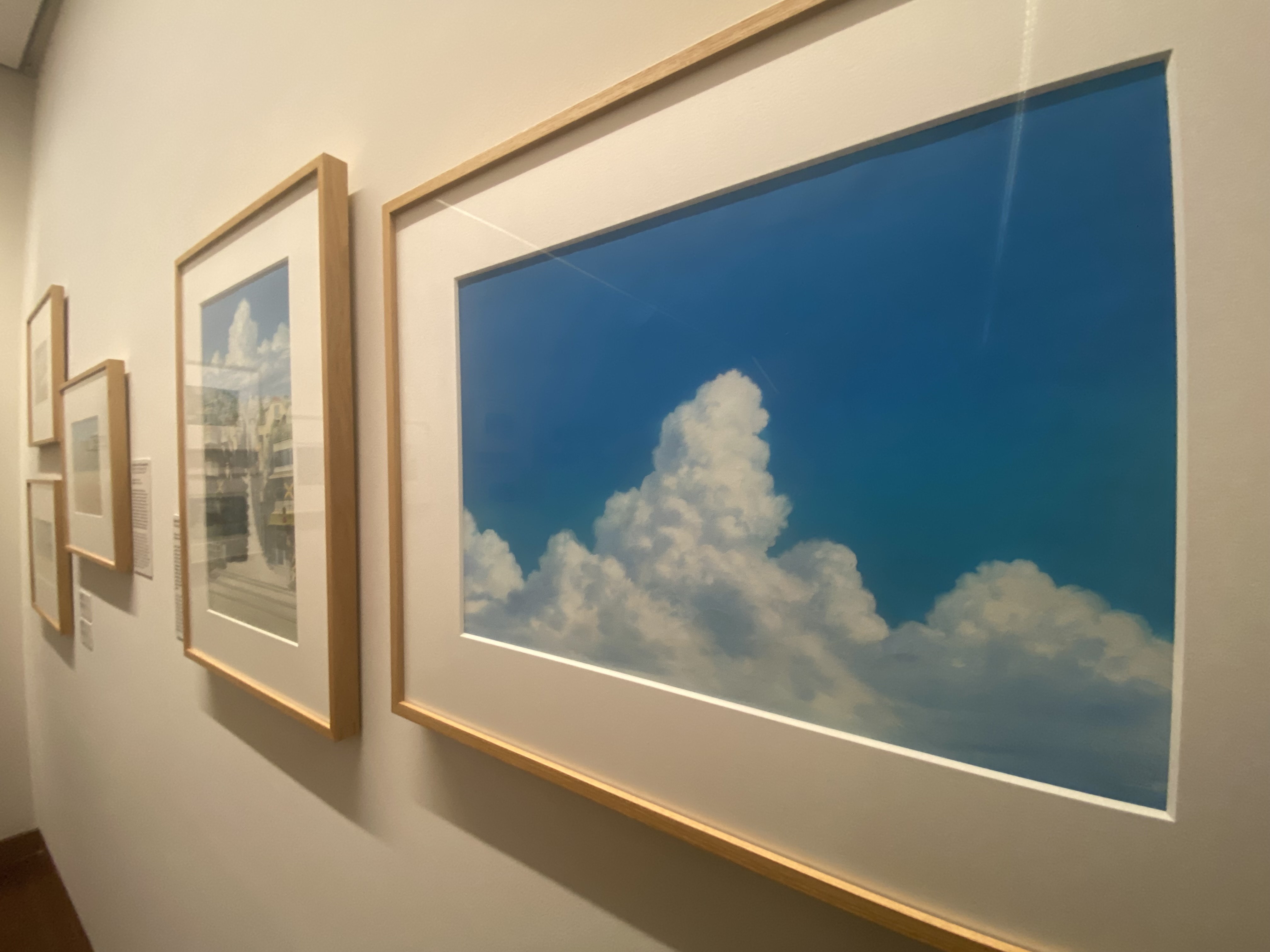
The artist spoke of his wish to draw the viewer’s eye naturally into the depth of an image. This intention also helps explain his later work outside cinema. Begun in 2010 and completed in 2021, One Hundred Views of Gotō applied his accumulated experience of depicting environments to his home islands. Since 2018, a museum devoted to his work has occupied a former samurai residence built in 1863 there.
Yamamoto died on 19 August 2023, aged seventy. According to the museum, he continued drawing a manga based on a local legend until his final days; of a draft running to approximately 120 pages, one remained unfinished.
The Berlin exhibition gives his works a different duration in front of the viewer. A background designed for twenty seconds can be studied independently of camera speed and narrative development. Alongside the working drawings, it reveals decisions that the finished film combines into a continuous impression.
This is the significance of Yamamoto’s first comprehensive exhibition outside Japan. It allows us to understand more precisely the authorship of familiar worlds: to see how an impression of naturalness emerges from carefully considered space, and to distinguish an artist’s particular work behind the director’s name.